

It's Wednesday. The hardest power line to build is the one a hyperscaler decides it doesn't need. In the Northern Territory, the plan now is to skip the grid entirely and let the battery do the work the wires used to.
In today's edition:
🔋 The Big Story: an off-grid AI campus betting on a 16GWh battery
⚡ Quick Hits: a 1.6GWh battery goes live, China rewrites battery payment terms, and Germany breaks ground on 2.5GWh
💰 The Capital Stack: Enlight's $2.6B close and a behind-the-meter forecast
🏛️ Policy Watch: Europe signs its first storage pact, PJM picks a fast-track fight
📊 Chart of the Day: where all the data-center electricity actually goes
The Big Story
Energy North files a gigawatt AI campus that skips the grid entirely
Australian developer Energy North has submitted Project Ares, a 1GW hyperscale data center campus in the Northern Territory, for federal environmental assessment, with a power architecture that draws nothing from the public network. The design pairs roughly 3,000MWp of bifacial solar, a co-located battery scaling to about 16GWh, and 1,038MW of hydrogen-ready gas for firm backup, with the battery acting as the primary mechanism for keeping AI loads stable between solar generation and demand. It is one of the clearest expressions yet of the off-grid, solar-plus-storage-plus-gas model emerging as developers route around interconnection queues that now run past four years in Australia's data center hubs.
"Behind the meter, off grid infrastructure, designed to meet the availability, security and sustainability expectations of global hyperscale customers."
The campus targets 1GW of IT capacity in two phases, with Phase 1 around 500MW, built to Tier III availability standards that require fully independent firm power.
The co-located battery scales to roughly 16GWh, sized to smooth the rapid, unpredictable power draw of large GPU clusters that diesel gensets cannot follow.
Gas backup of about 1,038MW is specified as hydrogen-ready, signaling an intended transition off fossil firming as green hydrogen matures.
The site sits on Murranji Station in the Barkly Region, about 683km south of Darwin, with a separate green-ammonia export project proposed on the same lease.
Source: Energy-Storage News
Quick Hits
Technology milestones from across the grid
Storage did most of the talking, from Australia to China to the EU.
Akaysha Energy brought its 1,660MWh Orana battery into commercial operation in New South Wales, the third-largest system in Australia's NEM at commissioning, built from 448 Tesla Megapacks and backed by a 12-year virtual tolling deal with EnergyAustralia. ESD News
Neoen Australia started construction on a 215MW/963MWh battery co-located with its 440MWp Culcairn solar farm in New South Wales, the developer's first behind-the-meter battery paired directly to a solar plant. Renewables Now
Wood Mackenzie and the ACP reported the US installed a record 3.3GW/8.4GWh of storage in Q1 2026, up 54% over the prior Q1 record, with residential additions up 86% year on year. Wood Mackenzie
CATL and CALB backed a CNESA-led initiative capping supplier payment terms at 60 days across China's battery industry, a structural move to ease the cash-flow squeeze on the world's largest cell supply chain. electrive
EnBW, Elements Green and VPI advanced roughly 2.5GWh of battery storage across Germany, with EnBW and VPI breaking ground and Elements Green lining up suppliers for a separate 400MW/1,600MWh project, as the country pushes toward its 80% renewables target. Energy-Storage.news
The Capital Stack
Enlight locks $2.6 billion for its largest US solar-and-storage build
Enlight Renewable Energy's US arm Clēnera reached financial close on roughly $2.6 billion in debt for the CO Bar Complex in Arizona, five projects totaling about 1.2GW of solar and 4.0GWh of storage, fully subscribed under 20-year offtake agreements with Salt River Project and Arizona Public Service. Seven global banks provided the financing at a 5.9% all-in rate on a mini-perm structure, with phased commercial operation expected across the second half of 2027 and first half of 2028.
Source: StockTitan
Also in the capital stack:
A new SemiAnalysis model argues US grid constraints are pushing the industry toward more than 40GW of behind-the-meter data-center power by 2028, a thesis that turns on-site batteries and generation into the fastest path to compute. SemiAnalysis
Policy Watch
The European Commission and 22 member states signed the bloc's first-ever tripartite energy storage agreement, with pledges of up to 45GW of new capacity by 2028 to cut gas dependence; the deal pairs national commitments with EU oversight and annual progress reviews, and is meant to de-risk the buildout toward the ~200GW the EU needs by 2030. pv magazine
PJM urged FERC to deny a waiver that would let Advanced Power's roughly $2 billion, ~1.3GW Chestnut Run gas plant in Ohio stay in its fast-track Reliability Resource Initiative after switching to smaller GE Vernova turbines amid a backlog, arguing the change would unfairly advantage one developer over rivals following the rules; it is an early test of how rigid the shovel-ready fast-track stays as turbine shortages reshape gas projects. Utility Dive
Chart of the Day
The data-center load curve that's reshaping the grid
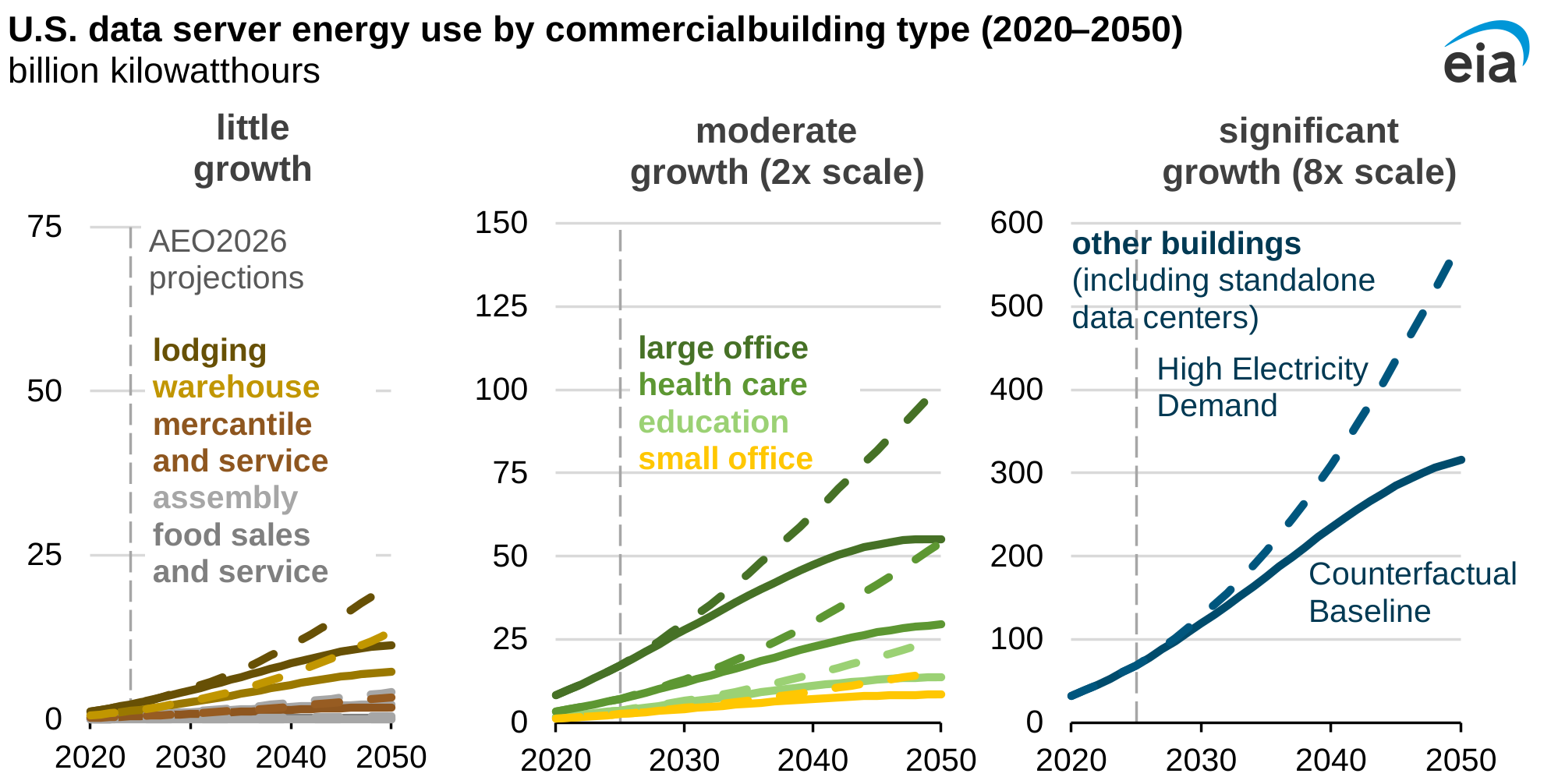
Data-center servers alone made up about 7% of US commercial-sector electricity in 2025, and the EIA projects that share climbs to between 22% and 33% by 2050, with standalone data centers growing faster than every other building type combined. It is the demand curve driving every off-grid campus and behind-the-meter deal in today's issue.
Source: EIA Today in Energy
Who We Follow
And you should too!


Loved it? Forward it.
And reply back with some news and stories we should include tomorrow!