

It's Tuesday. The battery drawing the most attention this week stores its charge in a tank of water-based liquid, and it is shipping to a Maldivian island that still burns imported diesel to keep the lights on.
In today's edition:
🔋 A flow battery hits its first commercial deployment overseas
⚡ Small bites: a national-grid reconductoring push, a data-center power block, and a reactor goes critical
💰 The Capital Stack: fuel cells scale up for AI load
🏛️ Policy Watch: Brussels signs a storage pact and Virginia coins a word
📊 Chart of the Day: how rooftop solar is rewriting New York's demand curve
The Big Story
Quino deploys its first commercial flow battery overseas
Flow-battery startup Quino Energy has been selected by Tencent's CarbonX program to fund a megawatt-hour-scale, water-based organic flow battery on Himandhoo Island in the Maldives, the company's first commercial deployment of the technology outside the United States. The system will pair with a floating solar array financed by the Asian Development Bank and is meant to cut the island's reliance on imported diesel, complementing the government's POISED program that is converting roughly 160 islands from diesel to solar-plus-storage. Quino's proprietary organic electrolyte will be manufactured in Pune, India by partner Atri Energy Transition, with hardware supplied by China's Suqian Time Energy Storage.
"This represents the first commercial deployment of the company's organic flow battery technology, in addition to previously announced government-supported projects."
The Maldives award follows Quino's US footprint: a $10M California Energy Commission grant for an 8 MWh system in Lancaster and $5M from the DOE's CiFER program for a 5 MWh deployment in Southern California.
Organic flow chemistry uses earth-abundant, water-based electrolytes rather than vanadium or lithium, a pitch aimed at long-duration storage where cycle life and safety matter more than energy density.
In a companion project covered in the same report, the Paskenta Band of Nomlaki Indians is pairing lithium-ion with Eos zinc hybrid cathode long-duration storage across 4.5 MW of solar and 21 MWh of batteries in Northern California, using OATI's GridMind controls to island from the grid during wildfires and outages.
The two deployments land as non-lithium chemistries push from pilots into paid, grid-connected service.
Source: Energy-Storage News
Quick Hits
Small bites from across the grid.
Storage led the weekend, but the rest of the stack kept moving.
MUD is building Dry Creek, a 160 MW/640 MWh battery, inside the fenced footprint of the decommissioned Rancho Seco nuclear plant in California, reusing the retired reactor's grid connection to avoid costly system upgrades. SMUD
National Grid appointed Balfour Beatty, M Group, Morgan Sindall, Murphy and Omexom Taylor Woodrow to the next £1.2bn phase of its Electricity Transmission Partnership, centered on major reconductoring to lift overhead-line capacity across England and Wales. New Civil Engineer
FuelCell Energy introduced a standardized 12.5 MW packaged power block for grid-constrained data centers and signed an agreement with Fit Energy for up to 380 MW of fuel-cell capacity. FuelCell Energy
NYSERDA opened $24M for grid-enhancing technologies, funding dynamic line rating, advanced power-flow control and related kit to squeeze more capacity out of New York's existing transmission and distribution network. NYSERDA
Valar Atomics brought its Ward 250 reactor to criticality, the second advanced reactor to go critical under the DOE Reactor Pilot Program ahead of the program's July 4 target for three designs. POWER
The Capital Stack
Fuel cells angle for the AI-load buildout
FuelCell Energy is packaging its technology for speed, debuting a standardized 12.5 MW utility-grade power block and announcing a manufacturing expansion to meet data-center demand, alongside an agreement with Fit Energy for up to 380 MW of clean power. The move slots fuel cells into the same behind-the-meter race as gas turbines and batteries, where developers are choosing onsite generation over multi-year interconnection queues.
Source: FuelCell Energy
Also in the capital stack:
The European Investment Bank said it will extend its €1.5bn Grids manufacturing package to cover storage-component manufacturers, adding equity and debt instruments to build out an EU storage supply chain. Energy-Storage News
Policy Watch
The European Commission signed a first-of-its-kind tripartite energy-storage agreement, with 22 of 27 member states pledging 30-35 GW of new capacity by 2028 (the agreement document cites 45 GW), targeting storage to meet 10% of peak demand by 2028, up from 5% in 2025. It sends a market signal for deployment and EU manufacturing as the bloc chases roughly 200 GW of storage by 2030 from about 55 GW today. Energy-Storage News
Virginia Gov. Spanberger signed SB 340/HB 508 codifying a state definition of "agrivoltaics," the intentional co-location of farming and solar on the same land, a move that clears a siting and land-use path for solar developers facing rural pushback. Utility Dive
The DOE Reactor Pilot Program is racing toward its July 4 target of three advanced reactors reaching criticality outside the national labs, a deadline set by Executive Order 14301 that is becoming a de facto fast-track precedent for advanced-reactor licensing. POWER
Chart of the Day
Rooftop solar is bending New York's demand curve
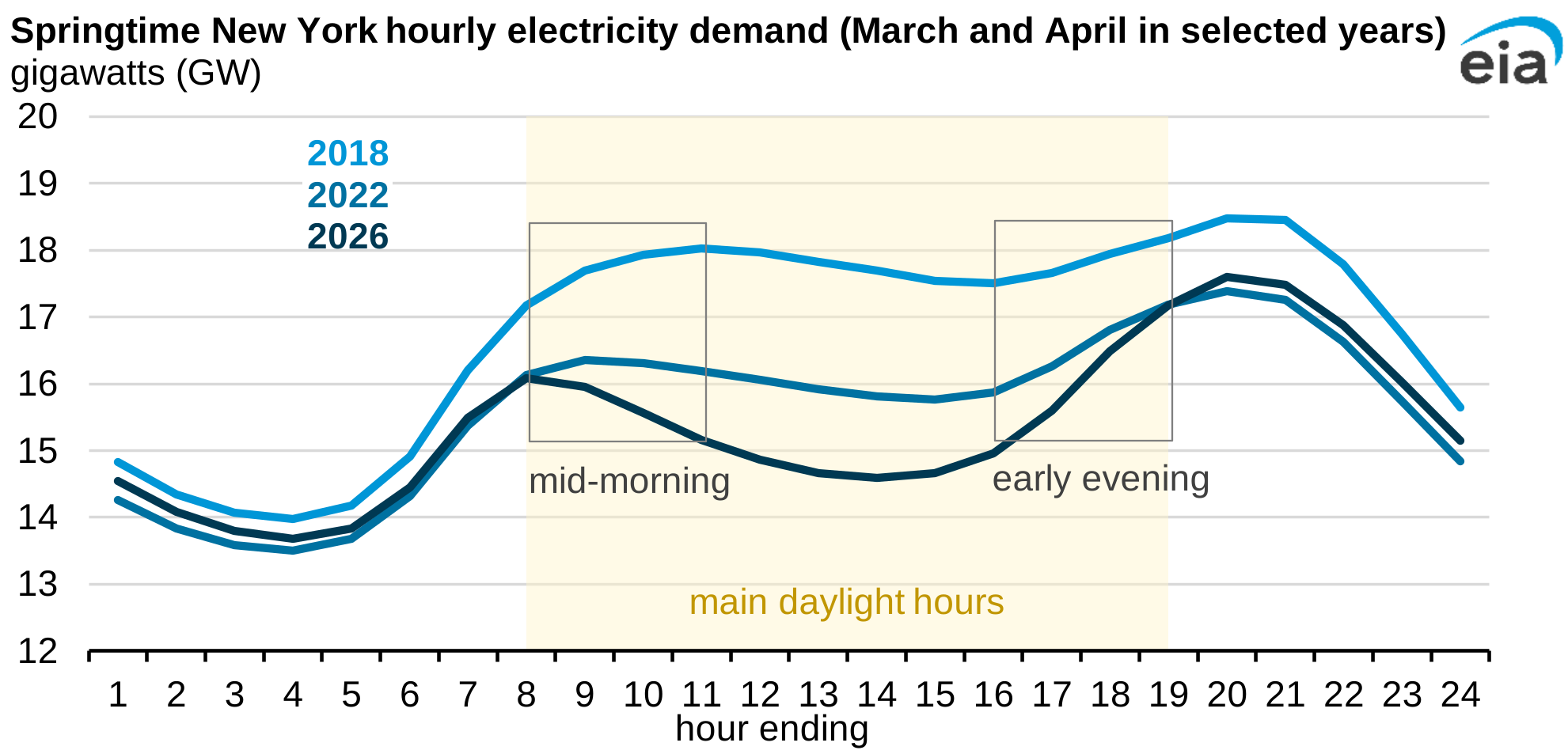
Metered demand in New York that climbed an average 850 MW between 8 and 11 a.m. in spring 2018 now falls 923 MW over those same hours, while the early-evening ramp has more than tripled to an average 2,221 MW between 4 and 7 p.m. New York has added 5.6 GW of solar since 2018, roughly half of it small-scale and behind-the-meter, sharpening the duck curve grid operators have to balance.
Source: EIA, Today in Energy, June 26, 2026
Who We Follow
And you should too!


Loved it? Forward it.
And reply back with some news and stories we should include tomorrow!