

It's Tuesday. The newest grid battery in New York weighs 305 pounds, plugs into a standard wall outlet, and cooks dinner.
In today's edition:
🔋 A Brooklyn warehouse is turning stoves into grid assets
⚡ Quick Hits: Tesla's record storage quarter, a $900M nuclear fuel pivot, and who's actually raising your power bill
💰 Capital: Engie contracts 625 MWh of Spanish flexibility, and a 4.2 GW private SMR bet
📋 Policy Watch: a coalition pushes FERC on transmission speed, and the OBBB turns one
📊 Chart: 250 years of American energy in one picture
The Big Story
Electra ships induction stoves that double as grid batteries.
Brooklyn startup Electra began shipping its battery-equipped induction stoves in April and has now delivered 75 units, with thousands more planned by the end of the year, Canary Media reports from the company's Bushwick assembly line. Each 305-pound appliance pairs an induction cooktop with a slim 5-kilowatt-hour lithium iron phosphate battery, letting it plug into a standard 120-volt outlet instead of requiring a 240-volt circuit, and turning one of the most beloved appliances in the house into dispatchable grid capacity.
"It became clear that the straightforward thing to do is to colocate a battery with the biggest loads in the house, which are water heating, refrigeration, HVAC, and cooking. And when you look at it that way, there is one that people care about. People love their stoves."
The $3,999 stove plugs into a standard 120-volt outlet, skipping the panel upgrades, rewiring, and electrician visits that can add thousands of dollars to a conventional 240-volt induction install.
Through software partners, the batteries charge when solar production is abundant or rates are low and discharge during grid peaks; Electra estimates the appliance draws roughly 80% less peak power than a typical electric-resistance stove.
Early fleet data shows even frequent cooks use only about a fifth of the battery's capacity per day, which bodes well for the LFP pack's longevity, and the battery can cook through several meals in a blackout.
Pilots are lining up: a kitchen-electrification program with the city of Burbank, California, and an 80-unit apartment building in the Bronx, while rival Copper has sold over 1,000 units and won $32 million to put 10,000 battery stoves in NYC public housing.
Source: Canary Media
Quick Hits
Small bites from across the grid.
Back from the long weekend: a record storage quarter, first electrons offshore, a nuclear fuel pivot, and a study on who is actually raising rates.
Tesla deployed a record-pace 13.5 GWh of energy storage in the second quarter, announced alongside its July earnings date, as investors watch the 16 GW Tesla/Sunrun/Renew Home virtual power plant push and Musk's talk of 100 GW of US solar manufacturing. pv magazine USA
Centrus signed a $900 million fixed-price DOE contract that pivots its Piketon, Ohio enrichment plant, the only US-owned HALEU cascade, from demonstration to commercial production, with first new capacity due by 2029 to fuel the advanced-reactor pipeline. POWER Magazine
Ecowende, the Shell-Eneco-Chubu joint venture, delivered first power Monday from its 760 MW Hollandse Kust West offshore wind farm to TenneT's Dutch offshore grid, putting the 52-turbine project on track for full operation by the end of 2026, when it is expected to supply about 3% of the Netherlands' electricity. Eneco
Columbia University's Center on Global Energy Policy published a study finding that aging infrastructure, grid hardening, and fuel costs did more than AI data-center demand to push 2025 residential electricity prices to over twice the rate of inflation, with investor-owned utilities seeking a record $18.2 billion in rate base increases last year against $8.2 billion in 2019. T&D World
Duke Energy proposed a first-of-its-kind "large load tariff" for data centers in North Carolina, with 75% minimum bills, 10-to-15-year contract terms, and a 50 MW floor, filed just ahead of rate-hike hearings that open July 7. Canary Media
Amazon signed a power purchase agreement covering European Energy's 220 MWh Winton North solar-plus-storage project in Victoria, extending the hyperscaler storage-procurement playbook to Australia's grid. Energy-Storage.news
The Capital Stack
Engie contracts 625 MWh of Spanish battery flexibility.
Engie signed a long-term flexibility purchase agreement with developer Ignis covering 625 MWh of battery storage capacity in Spain, structured with a revenue floor and tolling elements. Merchant exposure has been the roadblock between Spain's grid-scale battery pipeline and bankable project finance, and a contracted offtake from a counterparty of Engie's size is an early marker that a real flexibility-trading market is forming in Europe's next big storage buildout.
Source: Energy-Storage News
Also in the capital stack:
Mainspring Energy, the linear-generator maker whose IPO rumors keep circulating, says it is getting more selective about its data-center pipeline as the AI power gold rush matures, a useful read on how onsite-generation vendors are separating real projects from speculative ones. Latitude Media
PPA prices are headed up as the OBBB's tax credits expire, analysts at Crux and Camelot Energy Group say, with one modeled 200 MW solar project needing mid-to-high $60s per MWh without the ITC versus $40 to $45 with it, a roughly 50% jump that shifts the delta from taxpayer to ratepayer. Utility Dive
Policy Watch
The Grid Acceleration Coalition urged FERC to speed up changes to federal transmission solicitation rules, arguing that streamlined competitive-solicitation requirements would cut project delays and costs; faster solicitation cycles would compress delivery timelines for exactly the transmission capacity that waiting large loads and generators are queued behind. T&D World
The Massachusetts Senate passed an omnibus energy bill that includes automated permitting for residential solar and batteries, adding the state to a New England wave (Connecticut enacted, Rhode Island advancing) that would take instant permitting from pilot to regional norm and cut soft costs on every rooftop install. pv magazine USA
The One Big Beautiful Bill Act turned one on Saturday, and with the July 4 commence-construction deadline now passed, Latitude Media's anniversary interview digs into what is still holding projects back, a checkpoint that matters because the industry's next four years run largely on the gigawatts developers managed to safe-harbor before the door closed. Latitude Media
Chart of the Day
250 years of American energy in one picture.
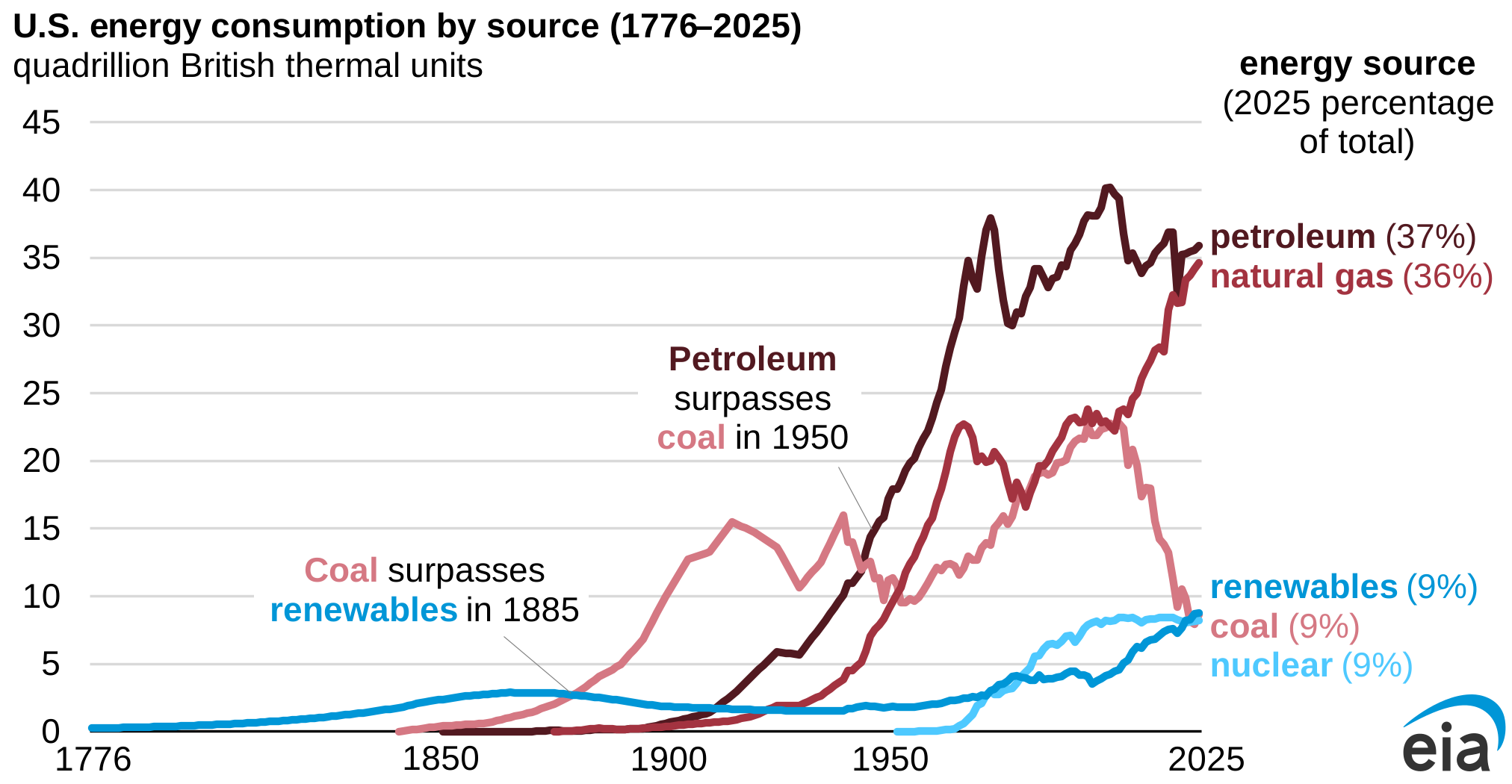
The United States ran on 96 quadrillion Btu of energy in 2025, up 2% from 2024 but still below 2007's record 99 quads, and EIA's semiquincentennial chart compresses the whole 250-year arc, wood to coal to petroleum to today's mix, into one frame; renewables, coal, and nuclear now each supply about 9% of the total.
Source: EIA Today in Energy · June 30, 2026
Who We Follow
And you should too!


Loved it? Forward it.
And reply back with some news and stories we should include tomorrow!