

It's Thursday. Nobody buys a solar project for the inverter. Every project now waits on one.
In today's edition:
🔌 Big Story: The FCC freezes authorizations for foreign-made inverters
⚡ Quick Hits: GM prices out bidirectional charging, AMD takes over a mining fleet
💰 Capital: MN8 buys Greenbacker to build a 6 GW platform
📋 Policy Watch: The transformer efficiency rule reopens
📊 Chart of the Day: Europe's biggest duck curve is in Spain
The Big Story
FCC blacklists foreign-made inverters, freezing new equipment authorizations.
The FCC's Public Safety and Homeland Security Bureau added foreign-produced power inverters to its Covered List on Tuesday, an action pv magazine USA reported as an immediate ban on new equipment authorizations for unapproved foreign models. Any solar or storage project relying on a foreign-built inverter without an FCC ID cannot legally interconnect, and the bureau set no phase-in, grandfather clause, or grace window. It reaches storage as much as solar, since both run on the same class of grid-forming power electronics.
"Because there is no phase-in period, grandfather clause, or grace window, the regulatory pipeline is frozen today, forcing developers to halt active procurements and find new hardware vendors."
The order overrides a January 2026 Department of Energy review that inspected 30 Chinese inverters and found no definitive evidence of hidden hardware. The White House interagency council concluded the exposure is digital, since wireless connectivity lets a maker push firmware remotely.
Department of Energy data cited in the report puts domestic manufacturers at seven percent of the US solar inverter market.
Developers plan to connect more than 58,000 MW of solar and storage over the next year, and swapping a banned model for a compliant one counts as a Material Modification, sending the project back for a mandatory engineering re-study.
The test is where final assembly happens rather than who owns the brand, so a foreign-owned manufacturer assembling in a US factory can still clear authorization. The only bypass is an emergency conditional approval through the Defense Department or Homeland Security.
Source: pv magazine USA · FCC order DA-26-786A1
Quick Hits
Technology milestones from across the grid
Four stories, from a bidirectional plug to an Australian megaproject.
General Motors commissioned an E3 study putting the US value of vehicle-to-grid at roughly $7 billion a year by 2030, about 15 times one-way managed charging, and $2,200 to $2,750 per vehicle per year in the most constrained ISOs. Utility Dive
Core Scientific signed AMD as a customer at five of its sites, converting another block of already-interconnected bitcoin mining capacity into AI hosting rather than queuing for new megawatts. Data Center Dynamics
Rhodium Group published an outlook finding the US clean energy build keeps growing through 2030, after which the firm says policy uncertainty makes the trajectory hard to call. Canary Media
Ark Energy locked in AU$1.3 billion of financing for the 2.2 GWh Richmond Valley solar-plus-storage site in New South Wales. Energy-Storage.news
The Capital Stack
MN8 Energy buys Greenbacker to assemble a 6 GW platform.
MN8 Energy agreed to acquire Greenbacker Renewable Energy for $375 million in cash and equity, a deal pv magazine USA reported would create a 6.2 GW operating platform across 33 states. With the federal credits that underwrote a decade of independent development now curtailed, buying an operating fleet is becoming cheaper than greenfield origination, and mid-sized IPPs are the obvious raw material.
Source: pv magazine USA
Also in the capital stack:
AirTrunk closed $2.3 billion of financing for JHB2, its second hyperscale campus in Johor Bahru, Malaysia, another multibillion-dollar debt package funding Southeast Asian data center load. Data Center Dynamics
Policy Watch
The Department of Energy is weighing changes to the 2024 distribution transformer efficiency rule, drawing opposition from EEI, APPA, NRECA and NEMA, who said reopening a settled standard would disrupt supply chains already years behind on transformer deliveries. Cleveland-Cliffs backs the revision. Utility Dive
The EPA has proposed measures extending the life of Indiana coal plants as data center load builds in the state, which Canary Media reported would loosen coal-ash and wastewater protections. Keeping those units in the mix changes the economics of the storage and demand-flexibility procurements that would otherwise cover the same hours. Canary Media
Chart of the Day
Spain has Europe's most extreme duck curve.
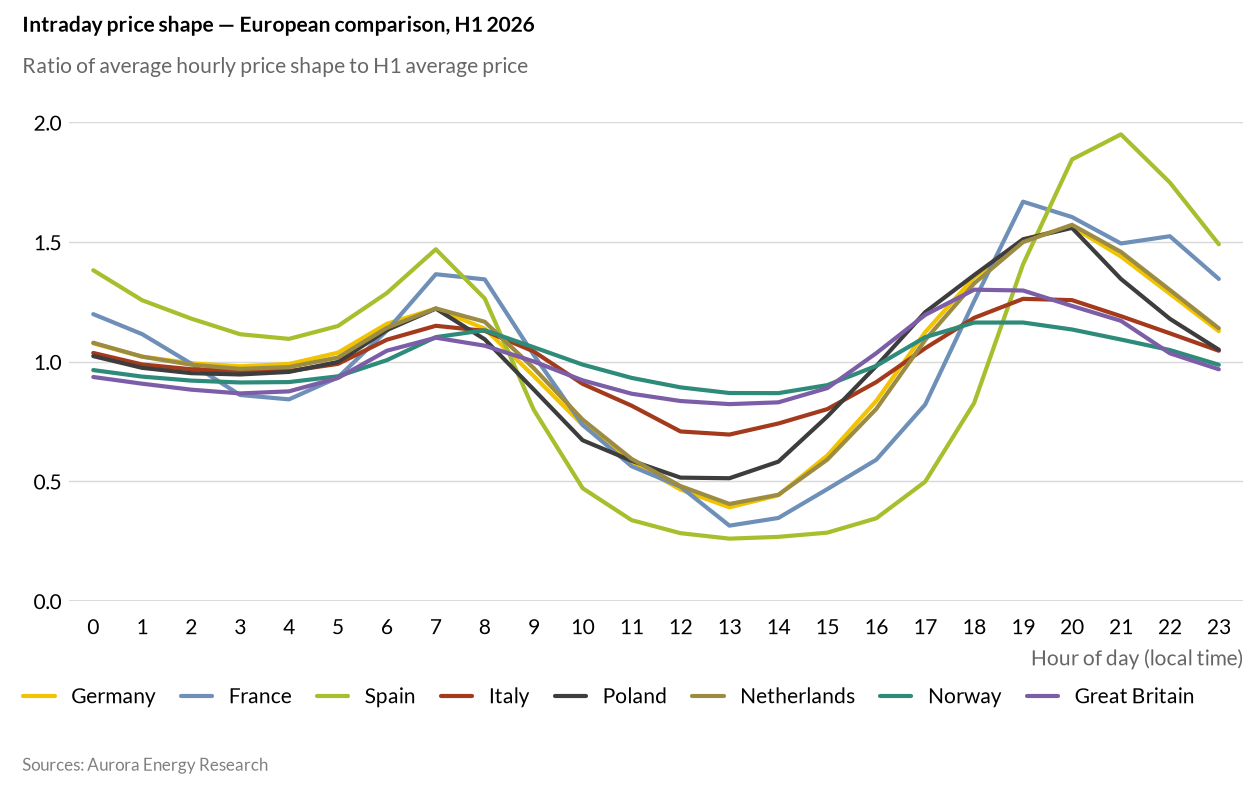
Spanish midday power prices average about a quarter of the first-half 2026 average before climbing to roughly double it by evening, a peak-to-trough ratio above 7:1 no other European market approaches. Chart by Richard Howard from Aurora Energy Research day-ahead data.
Source: Energetica · July 23, 2026
Who We Follow
And you should too!


Loved it? Forward it.
And reply back with some news and stories we should include tomorrow!