It's Thursday. The grid's next breakthrough may get decided in a simulation, weeks before anyone pours concrete. A startup running on NVIDIA's compute and Meta's atomic-scale model says it can sift billions of candidate compounds to find the ones nobody has made yet.
In today's edition:
🧪 Big Story: CuspAI stands up a 45-partner AI foundry to invent clean-energy materials
⚡ Quick Hits: a Minnesota megabattery permit, a federal off-grid AI campus, an Enphase software unlock
💰 Capital Stack: a $6M perovskite-ink seed and Prysmian's $6.29B data-center cabling deal
🏛️ Policy Watch: House data-center bills advance and Maine opens its first storage auction
📊 Chart of the Day: data centers on track for 9% of US power by 2030
The Big Story
CuspAI enlists 45 partners to hunt for materials that don't exist
CuspAI, an AI materials-discovery startup headquartered in Cambridge, England, launched what it calls the AI Materials Foundry, a network of more than 45 partner organizations aimed at discovering novel semiconductors and other materials for clean energy and advanced manufacturing. NVIDIA is providing the compute and Meta's Fundamental AI Research team is contributing its Universal Model for Atoms, a frontier chemistry model, while solar-linked members include perovskite specialists Caelux and Oxford PV alongside Applied Materials, 3M, and Fujifilm. CuspAI says its MIRA platform acts as an autonomous agent that generates candidate materials for simulation and testing, drawing on what it calls the largest curated experimental materials datasets in the world.
"The world needs materials that don't yet exist. That's what we're on a mission to solve – combining frontier agentic AI with deep domain expertise, exclusive data access and close customer partnerships."
The platform pairs training data, molecular-resolution screening across billions of candidates, synthesis infrastructure, and human expertise to move from digital design to a made material.
CuspAI built an open-source simulation toolkit called kUPS with NVIDIA's ALCHEMI lab; it uses Meta's UMA to model atomic interactions across the periodic table.
In a cited deployment for Finnish chemicals firm Kemira, CuspAI says its system screened as many as 300 trillion molecular structures to surface twenty candidates in six months, work it said would have taken years.
The launch lands alongside rival efforts including Google's GNoME and Microsoft's MatterGen, a sign AI-led materials design is becoming a competitive field.
Source: pv magazine USA
Quick Hits
Small bites from across the grid.
A thinner slate than usual today, spanning storage, data-center power, and residential software.
Spearmint Energy received a site permit for its 150MW/600MWh Midwater project in Freeborn County, Minnesota, one of the state's larger standalone batteries. Energy-Storage.news
DOE, Amentum, and DC Blox were selected to develop a behind-the-meter AI data center with on-site generation at the federal Savannah River site in South Carolina, a test of co-locating compute with dedicated power. Data Center Dynamics
Enphase pushed a software and hardware upgrade letting existing IQ Battery owners across Europe add backup power and expand capacity. GlobeNewswire
Sungrow brought a 70MW/160MWh battery system into commercial operation in Sweden, adding to a fast-growing Nordic storage market. SolarQuarter
The Capital Stack
Sofab Inks raises $6M to commercialize a novel perovskite electron-transport layer
Sofab Inks, a Kentucky startup, announced $6 million in funding to advance a metal-oxide electron transport layer it says is up to ten times more effective than conventional materials for perovskite solar cells. The raise is small in dollar terms but sits at the materials layer where perovskite durability and efficiency are won or lost, landing the same week CuspAI put AI-led materials discovery on the industry's front page.
Source: pv magazine USA
Also in the capital stack:
Prysmian signed an up-to-$6.29 billion, roughly ten-year optical connectivity supply agreement with Molex to serve AI data centers, one of the larger picks-and-shovels commitments to the buildout. Data Center Dynamics
Policy Watch
House Energy and Commerce Committee advanced a package of data-center and grid-demand bills at a July 21 markup, with some members pressing for a moratorium, putting large-load interconnection squarely in a federal fight. RTO Insider
Maine's Department of Energy Resources unveiled plans for the state's first competitive storage solicitation of up to 360MW, a new channel that could seed a merchant storage market in northern New England. Energy-Storage.news
Chart of the Day
Data centers could reach 9% of US electricity by 2030
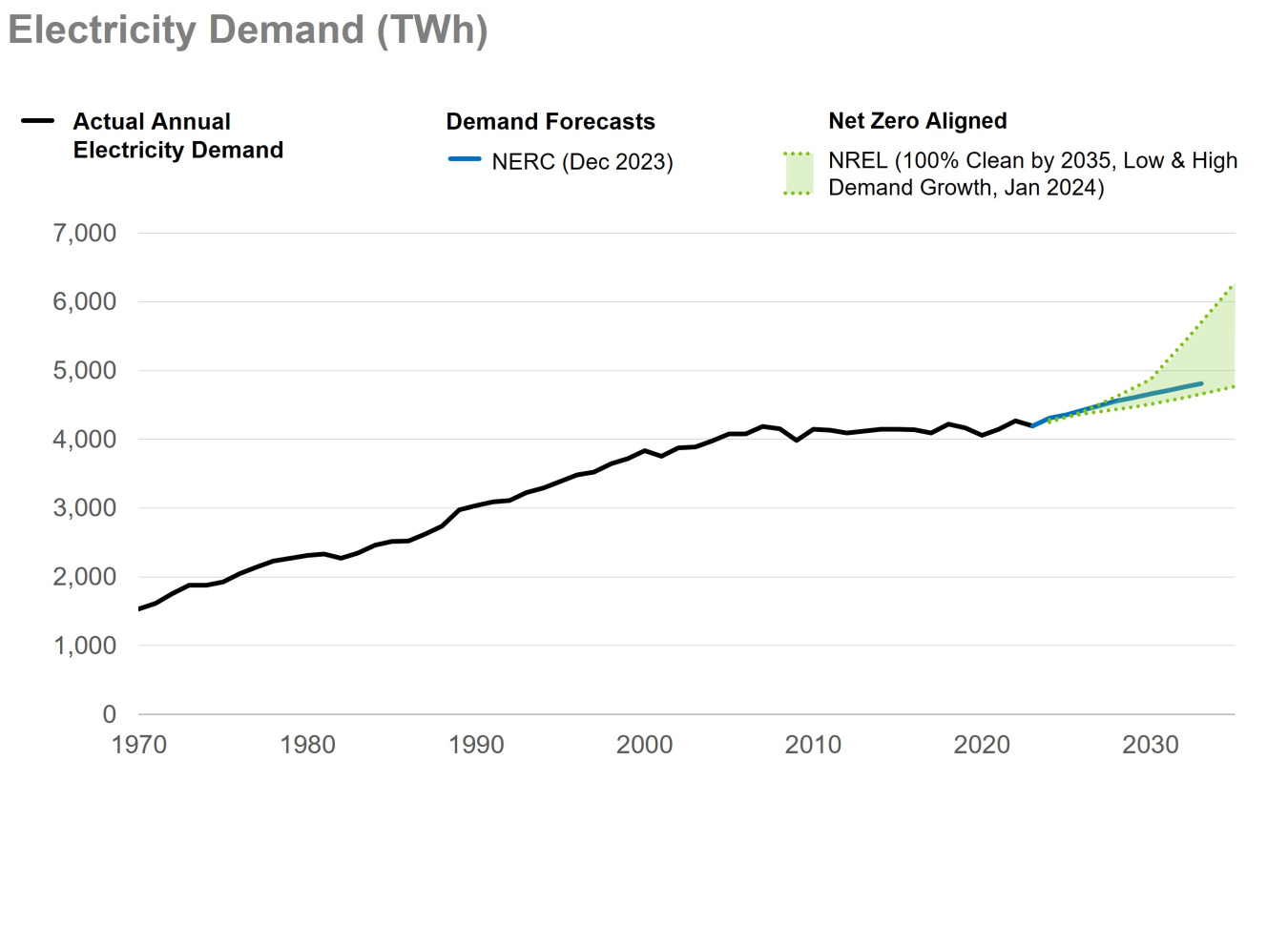
The Electric Power Research Institute estimates data centers could consume up to 9% of US electricity by 2030, up from 4% of load in 2023, part of a broader 15 to 20% rise in total demand DOE projects over the next decade.
Source: DOE Office of Electricity
Who We Follow
And you should too!


Loved it? Forward it.
And reply back with some news and stories we should include tomorrow!