

It's Friday. The world's most powerful laser does not exist yet, and neither does the factory that would feed it fuel pellets by the thousand. A Livermore spinoff just published the schedule for building both.
In today's edition:
🔬 Big Story: A Livermore fusion spinoff puts a commercialization schedule on the table
⚡ Quick Hits: an AI-emissions yardstick, a Phoenix megaproject, an ultracapacitor pilot, and BC's first big battery
💰 Capital Stack: Avantus energizes a California megabattery and lines up $525M for the sequel
🏛️ Policy Watch: US power emissions tick up, and the decade-long FEOC clock on batteries
📊 Chart of the Day: battery storage's record-low $78/MWh now undercuts new gas
The Big Story
Inertia's 10-point roadmap aims to put laser fusion on the grid
Inertia Enterprises, a Lawrence Livermore National Laboratory spinoff, shared with Heatmap an exclusive 10-point roadmap for turning the lab's laser-driven fusion into a grid-scale power plant by the mid-2030s. The company, which raised a $450 million Series A earlier this year, is betting the hard physics is already settled: Livermore's National Ignition Facility got more energy out of a fusion reaction than the lasers put in back in 2022, and CEO Jeff Lawson argues the rest is engineering. The roadmap's milestones split between a laser system that would eventually run 1,000 units in concert and a line to mass-produce the millimeter-scale fuel targets a plant would need by the millions.
"There have been generations of scientists who've made their predictions about fusion energy and gotten it wrong. I'm not going to pretend to be smarter than them. All I'm here to say is, just knowing that one did work, we can commercialize it."
The National Ignition Facility today makes roughly a dozen fusion targets a year by hand; a grid-scale plant firing about 10 times a second would need on the order of a million a day.
Goal one is lifting target energy gain past 25 times the laser energy delivered; the facility's best shot so far has returned a little over four.
Inertia expects to finish the core laser and target-manufacturing components by the middle of next year, spend two to three years on prototype subsystems, then start a first-of-a-kind plant around 2030.
Source: Heatmap
Quick Hits
Small bites from across the grid.
Four stories from across the stack, from a carbon-accounting yardstick to a first-of-its-kind battery north of the border.
Watershed published a methodology that lets companies estimate the emissions from their AI use, an attempt to quantify AI-driven data-center demand that model providers keep opaque, the firm said. Heatmap
Salt River Project will ask its board in September to approve the Marigold Energy Center near Phoenix, a mixed project pairing roughly 400 MW of storage with 600 MW of solar and up to 675 MW of gas plus a new substation, a hedge against fast-rising Arizona load. Utility Dive
Acciona Energía switched on a Navarra pilot pairing ultracapacitors with lithium-ion batteries to test grid-forming and stability services for renewables, an early probe of whether ultracaps can steady inverter-based grids. pv magazine
BC Hydro and British Columbia are advancing what the utility says would be the province's first major grid-scale battery, an early foothold for storage in a hydro-dominated system. Energy-Storage.news
The Capital Stack
Avantus energizes a California megabattery and lines up $525M for the sequel
Avantus brought its 200 MW/500 MWh Aratina 1 solar-charged storage project online and secured $525 million to finance Aratina 2, a 150 MW/452 MWh phase, under a 15-year power-purchase agreement with Southern California Edison, the developer said. Together the phases hold 952 MWh, among the larger solar-plus-storage complexes in California's pipeline.
Source: pv magazine USA
Policy Watch
The US power sector's CO2 emissions rose about 4%, roughly 58 million metric tons, in 2025 as record generation and a 13% jump in coal use outpaced a 34% rise in solar, the EIA reported, a reminder that load growth is pulling fossil generation back even as clean capacity climbs. Utility Dive
FEOC compliance for batteries is a decade-long obligation, Intertek CEA analysts wrote, warning that US storage developers must keep projects clear of "foreign entity of concern" content for years to protect their tax credits, a lasting supply-chain constraint on a market still leaning on Chinese cells. Energy-Storage.news
Chart of the Day
Four-hour battery storage hit a record-low $78/MWh in 2025
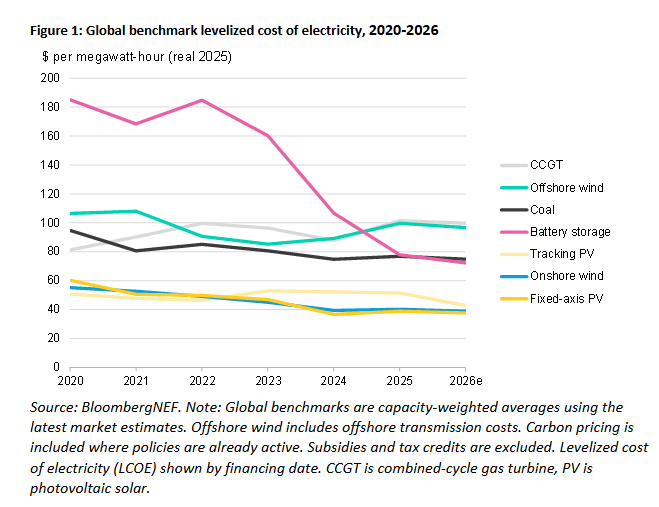
The global benchmark cost of a four-hour battery project fell 27% to a record-low $78 per MWh in 2025, even as a new combined-cycle gas plant climbed 16% to a record $102 per MWh on data-center-driven turbine demand.
Source: BloombergNEF
Who We Follow
And you should too!


Loved it? Forward it.
And reply back with some news and stories we should include tomorrow!