

It's Tuesday. The internet did not begin with a mandate. It began with a numbered document and a polite request that somebody try to poke holes in it.
In today's edition:
🔌 Big Story: AES and Fluence staff publish an open interconnection protocol
⚡ Quick Hits: a battery with no inverter, geothermal's quiet land grab
💰 Capital: storage cell shipments nearly double
📋 Policy Watch: DOE cancels three transmission corridors
📊 Chart of the Day: batteries move solar into the evening

Build energy apps with AI without exposing critical data.
Turn your operational data (SCADA, OMS, PI, etc.) into validated, audit-ready apps. Analysts ship in weeks without complicated IT workflows.
The Big Story
AES-led team publishes open protocol to speed grid interconnection.
A team led by AES Corporation senior vice president Chris Shelton has published a proposed Grid 2.0 protocol, designed as "a standardized, automated way to integrate load and supply" that speeds interconnection by relying on flexible service. Any utility or transmission operator could adopt it voluntarily, giving each interconnection customer a slice of firm service plus three progressively less assured tiers of flexible service, with new storage run as network-directed buffers. The five authors, four from AES and one from Fluence, have formed a Grid 2.0 Task Force modeled on the Internet Engineering Task Force and published the proposal as "G2TF RFC #1," open for comment. Nobody has adopted it.
"Version 1 of the protocol will likely first be deployed with a large load, because existing interconnection and transmission policies make this the easier implementation path."
The authors argue planning has historically overbuilt for peaks that account for as little as 30 hours a year, and that decoupling system access from critical-peak planning would raise utilization of infrastructure already in the ground.
It is pitched as a standardized version of the connect-and-manage arrangements PJM, SPP and ERCOT have each announced separately for flexible large loads.
Supporting organizations listed are AES Next, Fluence, and Tapestry, the Google-incubated firm that has worked with PJM on interconnection applications.
Hall said two companion documents are planned, on expedited renewables interconnection and on network-directed storage.
Source: pv magazine USA
Quick Hits
Technology milestones from across the grid
Four stories off a thin weekend wire, from a battery with no inverter to India tendering wires for 12 GW.
Relectrify installed its first AC1 battery system in Renmark, South Australia, with YES Energy, which the company describes as the first commercial install of an architecture that removes the separate inverter from the BESS stack. Energy-Storage.news
Next-generation geothermal development may be running well ahead of what has been announced, Latitude Media reported, with anonymous land agents assembling acreage for buyers who are mostly not the startups everyone assumes. Latitude Media
Supernode, Australia's largest battery project, cut its land footprint by about a fifth as cell energy density improved, RenewEconomy reported, and its developer is weighing an extension past 5 GWh on the ground it freed. RenewEconomy
RECPDCL tendered three interstate transmission packages to evacuate 12 GW from Rajasthan's Phase IV renewable zone, a reminder that wires, not panels, set the pace in India's fastest-growing solar state. Mercom India
The Capital Stack
Global storage cell shipments nearly doubled in the first half.
Research firm InfoLink puts global energy storage cell shipments at 467.84 GWh in the first half of 2026, up 94.8% year over year, and names three structural shifts behind the number, according to pv magazine. A near doubling inside six months suggests cell supply has stopped being the binding constraint on storage deployment, which pushes the bottleneck back onto interconnection and offtake.
Source: pv magazine USA
Also in the capital stack:
Agastya Green Energy committed ₹78 billion, roughly $816 million, to build 12 GW each of solar ingot and wafer capacity in Andhra Pradesh, moving India further up a supply chain it has so far mostly assembled rather than made. Mercom India
Policy Watch
DOE cancelled three National Interest Electric Transmission Corridor designations, covering Lake Erie-Canada, the Southwestern Grid Connector and Tribal Energy Access, removing the federal permitting and financing backstop those interregional projects had been counting on. Utility Dive
FERC approved direct assignment of roughly $909 million of MISO Tranche 2.1 facilities built in PJM territory to ComEd and Duke Energy Ohio without competitive solicitation, with Commissioners Chang and Rosner concurring while pressing for routine interregional planning. Utility Dive
PJM filed a broad framework for managing large-load data center impacts alongside an accelerated interconnection path, according to Data Center Frontier, making the largest US market the live test of whether flexible service for big loads can be standardized. Data Center Frontier
Chart of the Day
Batteries could shift a third of new daily solar into the evening.
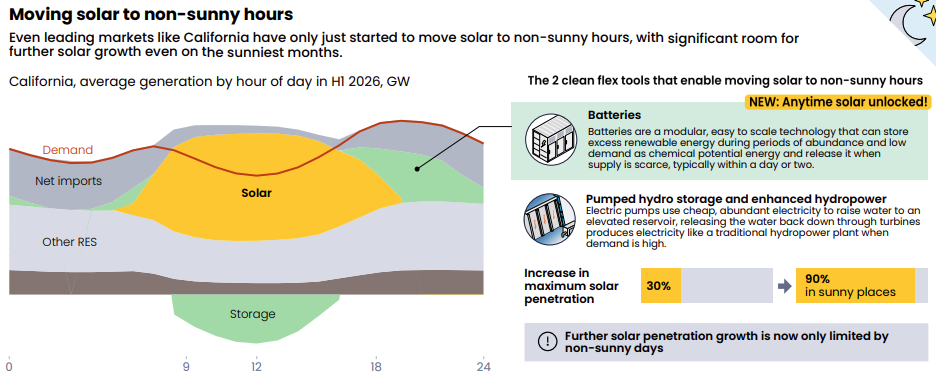
An anticipated 459 GWh of new battery capacity in 2026 could shift 34% of daily solar generation into non-sunny hours, up from 18% in 2025. Solar paired with storage already met more than a quarter of California's evening peak between 7 and 9 pm in the first half of 2026, and 24% of Bulgaria's. Ember calls the 34% a theoretical maximum, since not every battery is dedicated to shifting solar.
Source: Energy-Storage.news · August 17, 2026 · Chart by Ember
Who We Follow
And you should too!


Loved it? Forward it.
And reply back with some news and stories we should include tomorrow!